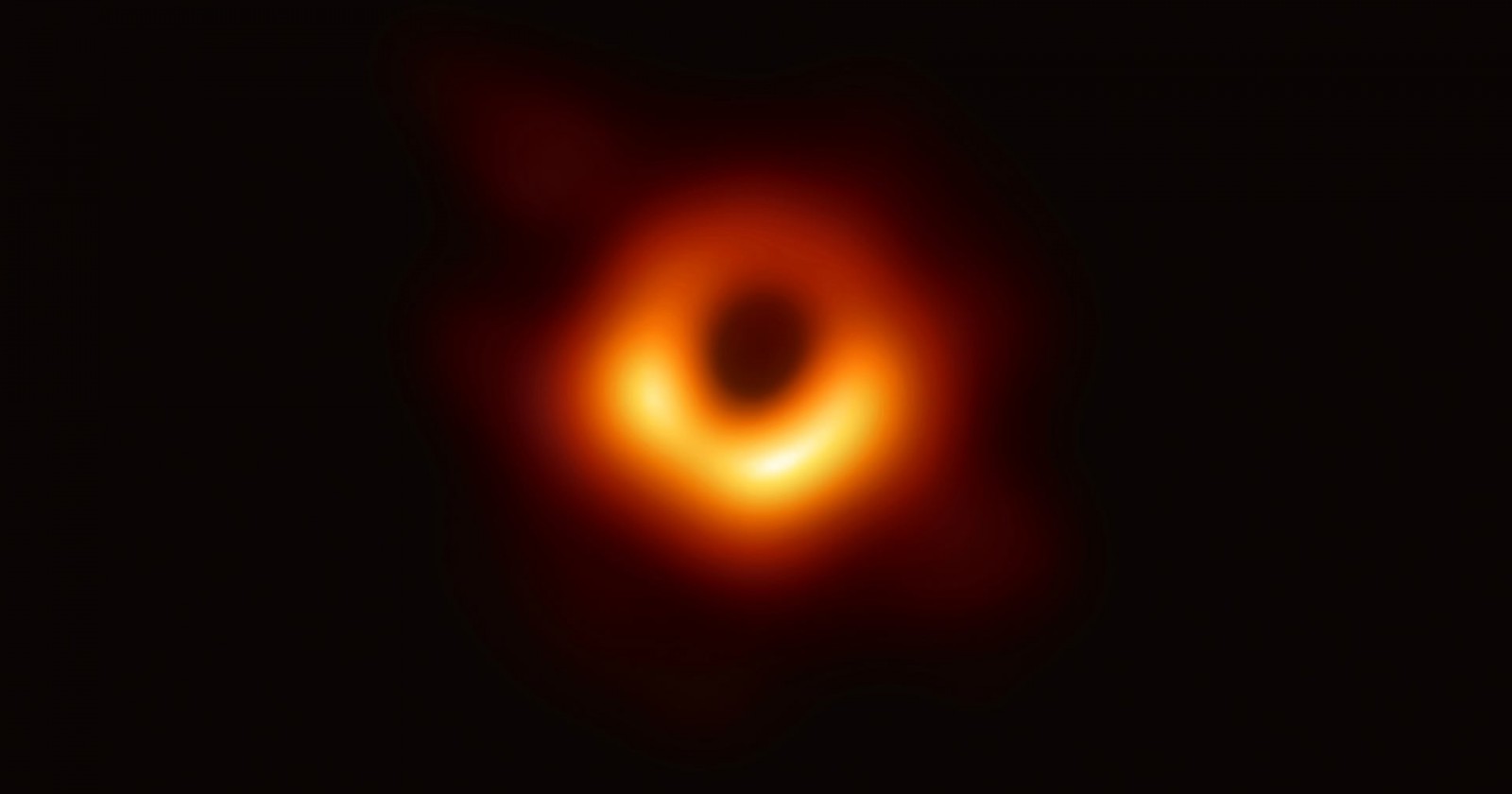
In Historic First, Researchers Public Black Hole Photo10.04.2019
The photograph was captured by a network of eight linked telescope across the globe.
“What we see is larger than the size of our entire Solar System,” says Professor Heino Falcke from the Radboud University in the Netherlands. Located in the M87 galaxy 55 billion light-years away from Earth, the black hole measures forty billion kilometers across, and is two and a half times that in diameter.
First attempts to take a picture of one of outer space most enigmatic objects were performed already in 2006, but insufficiently advanced equipment ultimately made it impossible. To remedy the technological shortcoming, the scientists from the international Event Horizon Telescope project have turned to a technique called very-long-baseline interferometry, which linked together a dozen of radiotelescopes scattered across the globe—from the South American Atacama Desert to the Spanish peak of Pico Veleta—into a single networked, Earth-sized radiotelescope, which allowed the research team to glean, for the first time ever, the way that light bends as it is captured by the intense gravitational field of the black hole, a phenomenon which prevented us from seeing it before. “The Event Horizon Telescope event has the observational power that a person in Paris could use to read a newspaper in New York,” says Dr. Monika Mościbrodzka, a member of the research team which captured the photo.
The photograph, potentially a groundbreaking achievement not just for astronomy, is surprisingly similar to earlier preconceptions about what a black hole would look like, developed by filmmakers, artists, or physicists themselves. “It is remarkable that the image we observe is so similar to that which we obtain from our theoretical calculations,” recounts Dr Ziri Younsi, of University College London. “So far, it looks like Einstein is correct once again,” he concluded.

see also
- Ted Fisher | Another person's life tells a richer story than I could imagine
 Papaya Rocks Film Festival
People
Ted Fisher | Another person's life tells a richer story than I could imagine
- Asif Ken Fernandes: Be creative in many aspects of life
 Papaya Rocks Film Festival
People
Asif Ken Fernandes: Be creative in many aspects of life
- Like a Loaded Weapon. See Felix Umarov’s "Eden"
 Papaya Films
News
Like a Loaded Weapon. See Felix Umarov’s "Eden"
- Kamila Tarabura: A Creative Bond
 Papaya Films
People
Kamila Tarabura: A Creative Bond


discover playlists
-
Andriej Tarkowski
 02
02Andriej Tarkowski
-
Branded Stories PYD 2020
 03
03Branded Stories PYD 2020
-
Lądowanie na Księżycu w 4K
 05
05Lądowanie na Księżycu w 4K
-
 05
05